Adding an ADU on an Eastside Costa Mesa Lot: The Plumbing Checks to Do First
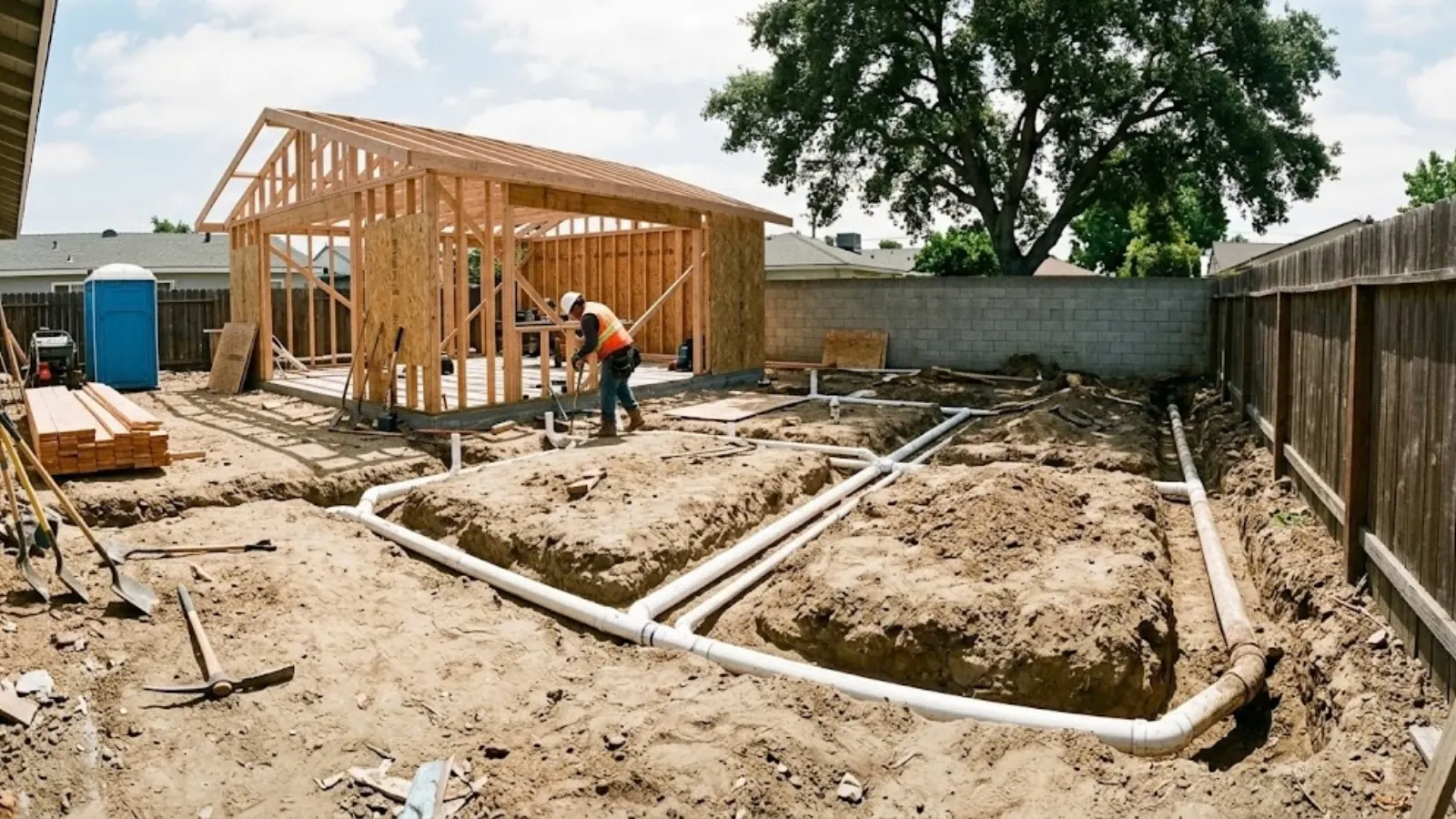
Before you design an accessory dwelling unit on an Eastside Costa Mesa lot, check three things: the condition of the existing sewer lateral, the size of the water service line and meter, and how the new unit will get hot water. Many Eastside homes are 1950s and early 1960s ranch houses, and their original lateral and service line were sized for one household. An ADU adds a second kitchen and bathroom to the same pipes.
A camera inspection and a pressure and flow check early in planning cost little and can change the whole design. The same checks apply on the 1960s lots of nearby Fountain Valley.
Why the plumbing check comes first
Eastside lots, many around 6,000 square feet, have room for a detached ADU or a garage conversion, which is why the neighborhood sees so many of them. The structure gets most of the attention in planning. The plumbing often gets looked at only when the trenches are open.
That order is backwards. If the existing lateral is cracked, root-filled or sagging, connecting a new unit to it just doubles the load on a pipe that is already failing. If the water service is undersized, both homes will see weak pressure when two showers run. Knowing this before the plans are final lets you design around it and budget for it.
The three checks, and what each tells you
| Check | How it is done | What it decides |
|---|---|---|
| Sewer lateral condition | Camera inspection from the house to the district main. | Whether to repair or replace the lateral before connecting. |
| Sewer route | Locate the lateral's path and depth. | Where the ADU's drain can tie in with proper slope. |
| Water service and meter | Measure pressure and flow at the house. | Whether a larger service or meter is needed. |
| Hot water | Review the main heater's capacity and location. | Shared heater, separate tank or tankless. |
| Gas, if used | Calculate total gas load. | Whether the gas line needs upsizing. |
The sewer lateral: the most common surprise
Costa Mesa makes the lateral the owner's pipe right up to the Costa Mesa Sanitary District's main, which usually runs down the middle of the street. On many Eastside lots, that lateral is original clay or cast iron, and camera inspections often find roots at joints or offset sections.
Filming it before design gives you three options. If the pipe is sound, the ADU can tie in. If it has a few bad joints, repair them as part of the project. If it is failing along its length, replace it once, sized for both units, rather than digging twice.
The Costa Mesa Sanitary District's inspection rebate can help with the camera run for eligible residents. See our guide to sewer camera inspections, and our lateral replacement page for the full-length fix.
Slope matters as much as condition. A detached ADU at the back of a lot needs enough fall to reach the house lateral. A plumber should confirm that before the unit's floor height is set.
What state law says about separate connections
California's ADU law limits when a city or special district can require an ADU to have its own utility connection. In general terms, an ADU created inside the existing home or garage usually cannot be forced to add a separate connection, while a new detached unit can be required to have one, with fees tied to its size or fixture count.
How that applies to your project depends on the unit type and the current rules of the city, the sanitary district and your water utility. Ask each agency early whether a new connection, a larger meter or a capacity fee applies. Those answers affect both the budget and the trench layout.
A plumbing sequence that avoids rework
- Film the lateral. Camera the whole run to the main and keep the video.
- Test pressure and flow. Measure at a hose bib with fixtures running.
- Ask the agencies. Confirm connection and fee rules with the city, CMSD and your water utility.
- Design the routes. Plan sewer slope, water, gas and the hot water source for both units.
- Fix the main house first. Repair or replace failing pipe before the ADU ties in.
- Permit and inspect. Work is inspected under the California Plumbing Code, based on the UPC.
Hot water options for the ADU
| Option | Works well when | Watch for |
|---|---|---|
| Share the main house heater | The ADU is attached or very close. | Long runs mean waiting for hot water. |
| Separate small tank | Detached unit with space for it. | Needs bracing, venting or a circuit. |
| Tankless in the ADU | Space is tight and gas or electric capacity allows. | Gas or electrical upgrades. |
| Heat pump water heater | Room and airflow, plus a circuit. | Incentives are limited in 2026. |
Our water heater comparison page compares these in more detail.
The main house often needs work anyway
Many Eastside homes still have original galvanized supply lines. Tying a new unit into a corroded supply system means both homes share low pressure and future leaks. An ADU project is a natural moment to repipe the main house, since trenches are already open and the water service may be replaced anyway.
If that is on the table, compare costs on our repiping page before the ADU plumbing is finalized. It is cheaper to plan one set of new lines than to replace the old ones a few years later.
Budget reality
The plumbing surprises on ADU projects are usually underground: a failing lateral, a service line that is too small, or a sewer connection that cannot reach the house with proper slope. Every one of those is cheaper to discover with a camera and a gauge than with an excavator. Put the checks at the top of the project, not the bottom.
ADU plumbing questions
Often, if the lateral is in good condition and the ADU can drain to it with proper slope. A camera inspection tells you whether it can.
It depends on the unit type and your water utility's rules. State law limits when a separate connection can be required. Ask your utility early.
If the house has old galvanized pipe, it is often the best time, since trenches and permits are already in motion.
The owner. In Costa Mesa the lateral is the owner's responsibility all the way to the district main.
ADU plumbing is part of the building permit and is inspected like any new plumbing.
Sources
- California Department of Housing and Community Development, ADU resources.
- Costa Mesa Sanitary District, Sewer Inspection Rebate Program.
General information only. For your home, a plumber on site has the final word.