Leak Detection in Costa Mesa, CA
Leak detection is the process of pinpointing a hidden water leak inside walls, under a slab or underground, without tearing things open to look. In Costa Mesa, CA, most callers do not know where the water is going. They only know the bill went up, the meter keeps turning, or a floor feels warm.
Our job is to find the exact spot first, so the repair opens one small area instead of a whole room.
The meter keeps moving but you cannot see water anywhere
These are the signs that send most people to a leak test. Any one of them is worth checking.
- The water bill jumped and nobody in the house changed their habits.
- The small leak indicator on the meter spins with every tap, toilet and sprinkler off.
- A warm spot on a tile or concrete floor, often near the kitchen or a bathroom.
- The sound of running water inside a wall when nothing is on.
- Damp drywall, lifting baseboards, or a musty smell in one closet or corner.
- A patch of lawn that stays green and soft when the rest of the yard is dry.
Check your own meter in ten minutes
Before you call anyone, this simple test tells you whether a leak exists and roughly where it is.
- Turn everything off. Close every faucet and shower, stop the washer, dishwasher and sprinklers, and make sure no toilet is refilling.
- Read the indicator. Open the meter box at the curb and watch the small triangle or dial on the meter face for two minutes.
- Close the house valve. Shut the main valve where the line enters your house and watch the meter again.
- Read the result. If the indicator stops, the leak is inside the house. If it keeps turning, the leak is in the line between the meter and the house or in the irrigation system.
Write down what you saw. It saves time on the call and helps us bring the right equipment.
If the bill is what tipped you off, our high-bill check covers the usual causes, and a stain on drywall is covered under ceiling and wall leaks.
Where hidden leaks show up in Costa Mesa homes
The type of home changes where we look first.
| Home type | Where leaks hide | What we use |
|---|---|---|
| 1950s and 1960s single-story ranch | Copper or galvanized lines under the slab and in exterior walls. | Acoustic listening and thermal imaging on the slab. |
| Homes with yards and sprinklers | The service line from the meter and irrigation valves. | Meter isolation and ground microphones. |
| Condos and townhomes | Shared walls and the unit above, or a common supply riser. | Moisture mapping and pressure tests by zone. |
| Homes with a pool or spa | Return lines and the equipment pad. | Pressure testing of each line. |
If the test points under the slab, the next step is slab leak work, where we compare a spot repair with rerouting the line. For a pool, see pool line testing.
How we pinpoint the leak
We start by splitting the plumbing into zones. Closing valves one at a time and watching the meter tells us whether the loss is in the service line, the hot side, the cold side or irrigation.
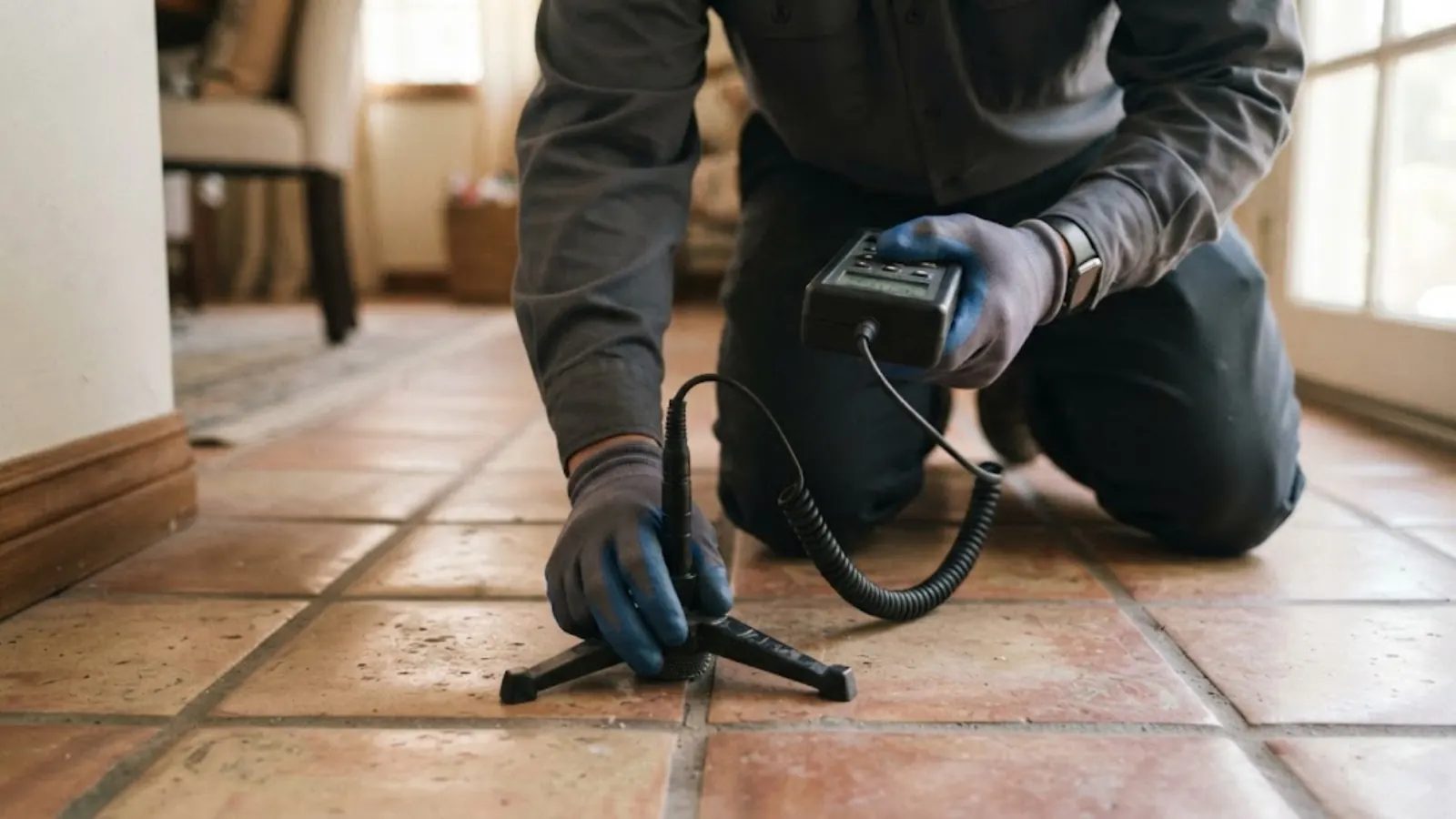
Then we narrow it down. Ground and floor microphones pick up the hiss of water escaping a pressurized pipe. A thermal camera shows the warm trail of a hot water leak through a slab or wall. On quiet or very slow leaks, a harmless tracer gas pushed into the line rises through the ground or floor, and a sensor finds it.
Pressure testing works the same way inspectors accept new supply piping under the California Plumbing Code, which is based on the Uniform Plumbing Code (UPC). A section is isolated, pressurized and watched on a gauge. If the gauge drops, the leak is in that section.
When the spot is confirmed, we mark it and walk you through the repair options before anything is cut.
Hot water leaks under a slab are often easier to find than cold ones. The heat shows up on the thermal camera even when the floor looks dry.
Who owns the leaking pipe
The meter and everything on the street side belong to your water utility. Most of Costa Mesa is served by Mesa Water District, and some addresses by the Irvine Ranch Water District. A leak in the meter box itself or the street is theirs to fix, so call them first if water is bubbling up at the curb.
On the house side of the meter, the pipes are usually the property owner's. Confirm the exact handoff point with your utility, since each agency sets its own rules.
Leak detection for businesses and rentals
Commercial spaces and multi-unit buildings add complications. Supply lines serve several units or restrooms, fixtures cannot always be shut off during business hours, and the leak may be in a ceiling above an occupied space.
We isolate the building by zone, test after hours when water can be shut down, and give the owner or property manager written findings. That record matters when a tenant, a neighbor and an insurer all need the same answer about where the water came from.
What happens after the leak is found
| Where the leak is | Usual next step | Covered on |
|---|---|---|
| Under the slab | Spot repair, reroute or repipe. | Slab leak repair. |
| In a wall | Open a small section, repair, patch. | This page and burst pipe repair. |
| Meter to house | Repair or replace the service line. | Water line repair. |
| Irrigation | Repair the line or valve. | Hose bib and outdoor repair. |
| Pool or spa | Seal the fitting or repair the line. | Pool leak detection. |
The detection visit ends with the leak marked and the options priced, so you choose the fix with the facts in hand.
What leak detection costs
Finding a leak is priced separately from fixing it. These factors set the detection price.
| Factor | Why it matters |
|---|---|
| Number of lines | A single suspect line tests faster than a whole house with irrigation and a pool. |
| Leak location | Slab and underground leaks take more equipment time than a wall behind a sink. |
| Leak speed | Very slow leaks may need tracer gas instead of acoustic listening. |
| Access | Furniture, flooring and finished ceilings affect how much we can test from the surface. |
| Time of day | An active leak after hours costs more than a scheduled daytime test. |
Insurance note: many homeowner policies pay for water damage from a sudden leak and sometimes for access to reach it, but not for the worn pipe itself. Keep the detection report, since insurers often ask for it.
Want your real number? Call (714) 750-8637 and describe the job.
Leak testing near you
We test homes, condos and small commercial spaces across 92626 and 92627 and in nearby cities like Westminster. If the leak turns out to be a failing tank, a water heater replacement is the fix. If the old pipes keep failing in different spots, a repipe is worth pricing.
Meter moving and no idea why? Let us find it.
Call (714) 750-8637Leak detection questions
Very likely. Run the ten-minute meter test above first. A spinning indicator in a silent house means water is getting out, and the usual suspects here are a slab line, a wall, or the sprinkler system.
Not to find it. Detection is done from the surface. Opening the floor or wall only happens at the repair stage, and only at the marked spot.
Most homes take one to three hours. Very slow leaks, or homes with pools and large irrigation systems, can take longer.
Yes. Moisture mapping and zone pressure tests show whether the water comes from your unit, the one above, or a shared riser. That answer usually decides whether you or the HOA handles the repair.
Yes. If water is visibly running, call any time. We will walk you to the shutoff first.
Yes. Tell us when you book and we will send the detection results and repair quote to the owner or property manager.
Yes. We test the irrigation system separately from the house supply, zone by zone, which shows whether a line or a valve is losing water.