Backflow Testing for Costa Mesa Businesses: What Is Required and How to Stay Compliant
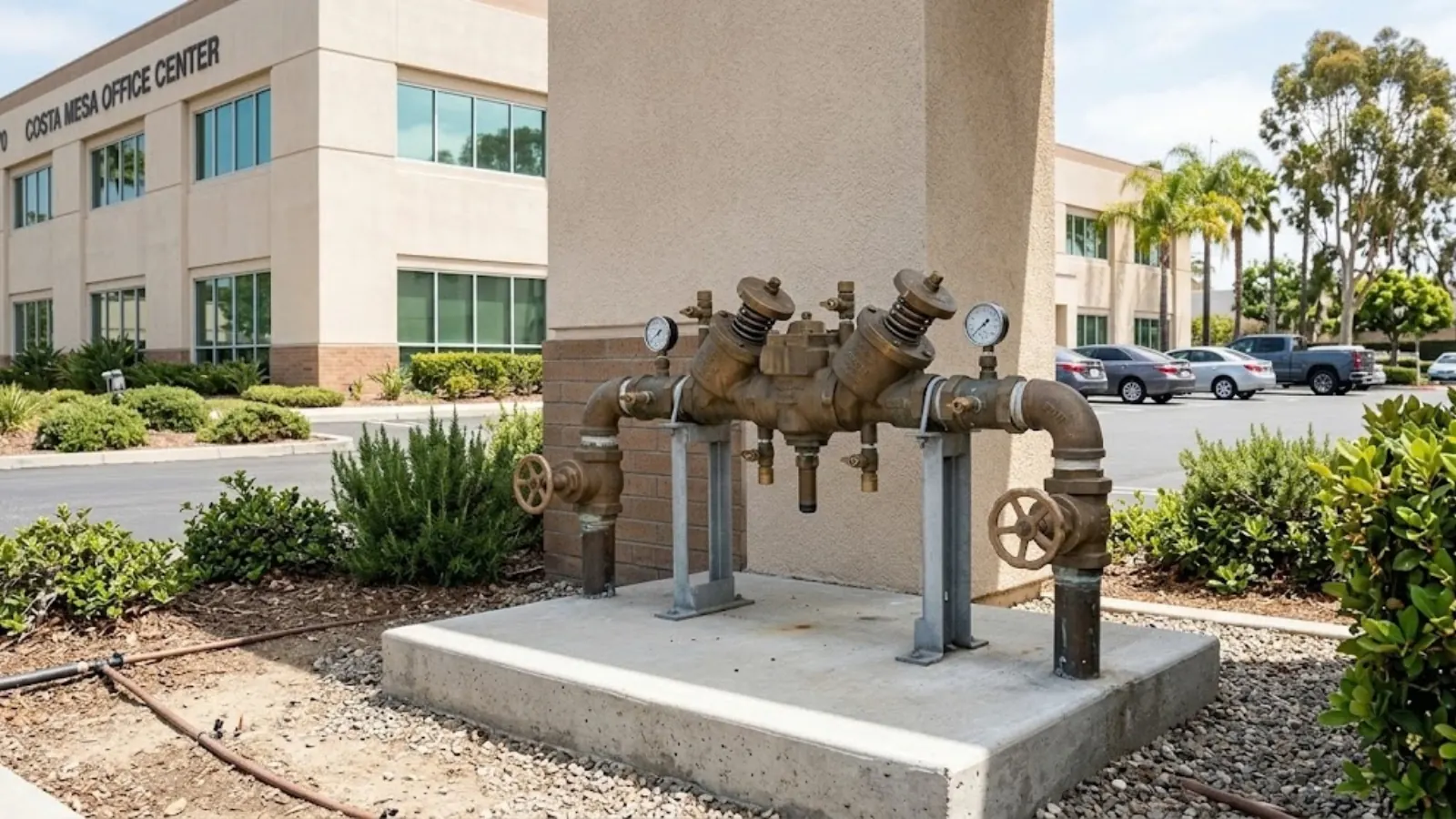
If your Costa Mesa business has a backflow prevention assembly, it must be tested every year. Mesa Water states that the federal Safe Drinking Water Act amendments, the California Code of Regulations and its own rules all require annual testing. Restaurants, medical and dental offices, salons, car washes, and any building with irrigation or a fire sprinkler line commonly have at least one assembly.
This guide explains what the assembly protects against, the common types, and how to stay ahead of test notices.
What backflow is and why businesses get extra attention
Backflow is water flowing the wrong way, from a building back into the public main. It happens when pressure in the street drops, from a main break or heavy hydrant use, or when pressure inside a building rises above the street supply. If something in the building is connected to the water system, it can be drawn back.
Businesses often have exactly those connections: chemical dispensers in kitchens, dental equipment, beauty product mixing, boilers, irrigation with fertilizer injection, and fire sprinkler systems. The assembly at the meter or on the line is what stops that water from reaching the public supply.
Which assembly you probably have
| Assembly | Typical use | Hazard level |
|---|---|---|
| Reduced pressure principle (RP) | Restaurants, medical, chemical use. | High hazard. |
| Double check valve | Fire sprinkler lines, some domestic services. | Lower hazard. |
| Pressure vacuum breaker (PVB) | Irrigation systems. | Back-siphonage from sprinklers. |
The utility decides what type is required for a given hazard. If your business changes, such as adding a chemical process, the required assembly can change too.
How the annual test works
- Notice. Your utility sends a notice when the test is due.
- Schedule. A certified tester books a time, often before opening or after closing.
- Test. A calibrated gauge checks each check valve and relief point.
- Repair if it fails. Worn parts are rebuilt or the assembly replaced, then retested.
- File the report. Passing results go to the utility in the format it requires.
Most tests take under an hour per assembly, and water is off only briefly.
When to call before the test date
These signs mean an assembly is likely to fail, or already has.
- Water discharging from the relief port of an RP assembly.
- A cracked body or bonnet, or a damaged enclosure.
- Leaking test cocks or shutoff valves.
- An irrigation vacuum breaker that sprays whenever the system starts.
Restaurants: backflow and grease together
Food businesses in Costa Mesa deal with two separate programs. Backflow testing protects the drinking water supply. The Costa Mesa Sanitary District's grease control program, which requires food service establishments to hold a wastewater discharge permit, protects the sewer.
Scheduling both kinds of maintenance together saves disruption. Many restaurants pair the annual backflow test with scheduled grease line jetting. Our commercial plumbing page covers both.
Keep a copy of every passing test report on site. Utilities follow up on missing tests, and a report on file ends the question quickly.
Businesses that often have more than one assembly
A single property can carry several assemblies, each with its own due date. A restaurant might have one on the domestic water service, another on the fire sprinkler line and a vacuum breaker on the landscape irrigation. A medical office building may add assemblies on specific equipment lines.
Multi-tenant buildings add another layer. In a strip center, the landlord may own the assemblies on the fire line and irrigation while each tenant owns the one serving its own space. When the notice arrives, the first question is whose assembly it is, and the lease usually answers it.
Car washes, dry cleaners, beauty salons and any business mixing chemicals with water tend to be treated as higher hazard. They usually need a reduced pressure principle assembly, which has more parts to test and a relief valve that must be installed where its discharge will not flood the space.
Why assemblies fail
Most failures come from ordinary wear. Rubber check valve seats harden, springs weaken, and debris from the water main lodges in a check and keeps it from closing fully. Debris is especially common after nearby main work or a hydrant flush.
Outdoor assemblies also fail from physical damage: a landscaper's mower, a vehicle backing into an enclosure, or tampering. A locked, well-placed enclosure prevents most of that. When an assembly fails, a rebuild kit restores most of them. Replacement is needed when the body is cracked or parts are no longer available.
Staying compliant, year after year
| Habit | Why it helps |
|---|---|
| Track each assembly's due date. | Notices can be missed during staff changes. |
| Keep test reports together. | Inspectors and landlords may ask for them. |
| Tell your utility about changes. | New equipment can change the required assembly. |
| Protect outdoor assemblies. | Damage and tampering cause failures. |
| Ask your landlord who is responsible. | Leases often assign testing to the tenant. |
Code and inside the building
The assembly at the meter protects the public system. Inside the building, the California Plumbing Code, which is based on the Uniform Plumbing Code (UPC), requires protection at individual connections too: hose bibs, mop sinks with chemical dispensers, and equipment tied into the water supply.
For the test itself and repairs, see our backflow testing page. Businesses in nearby cities can find local notes on our Garden Grove page.
Business backflow questions
Every year. Mesa Water requires annual testing of backflow prevention assemblies.
It is repaired or replaced and retested. The passing report is what the utility needs.
Yes. Most businesses schedule it before opening or after closing to avoid shutting off water.
The water account holder or whoever the lease assigns it to. Check your lease and the utility notice.
Possibly. New processes can raise the hazard level. Tell your utility before making changes.
A tester holding a current backflow tester certification, using a gauge that has been calibrated recently. The report usually lists both, and utilities check them.
Usually under an hour per assembly. Water is off only for a few minutes, so most businesses can test without closing.
Not usually, but repairs should be made promptly and the assembly retested, since the utility expects a passing report. Water discharging constantly from an RP relief port should be looked at the same day.
Where its relief valve can discharge safely without flooding the space, usually outdoors or near a drain, and where it can be reached for testing.
Sources
- Mesa Water District, How We Keep Your Water Clean and Safe (backflow prevention).
- Costa Mesa Sanitary District, business FOG prevention.
General information only. For your home, a plumber on site has the final word.