Is My Pool Leaking? How Costa Mesa Owners Can Tell Evaporation from a Leak
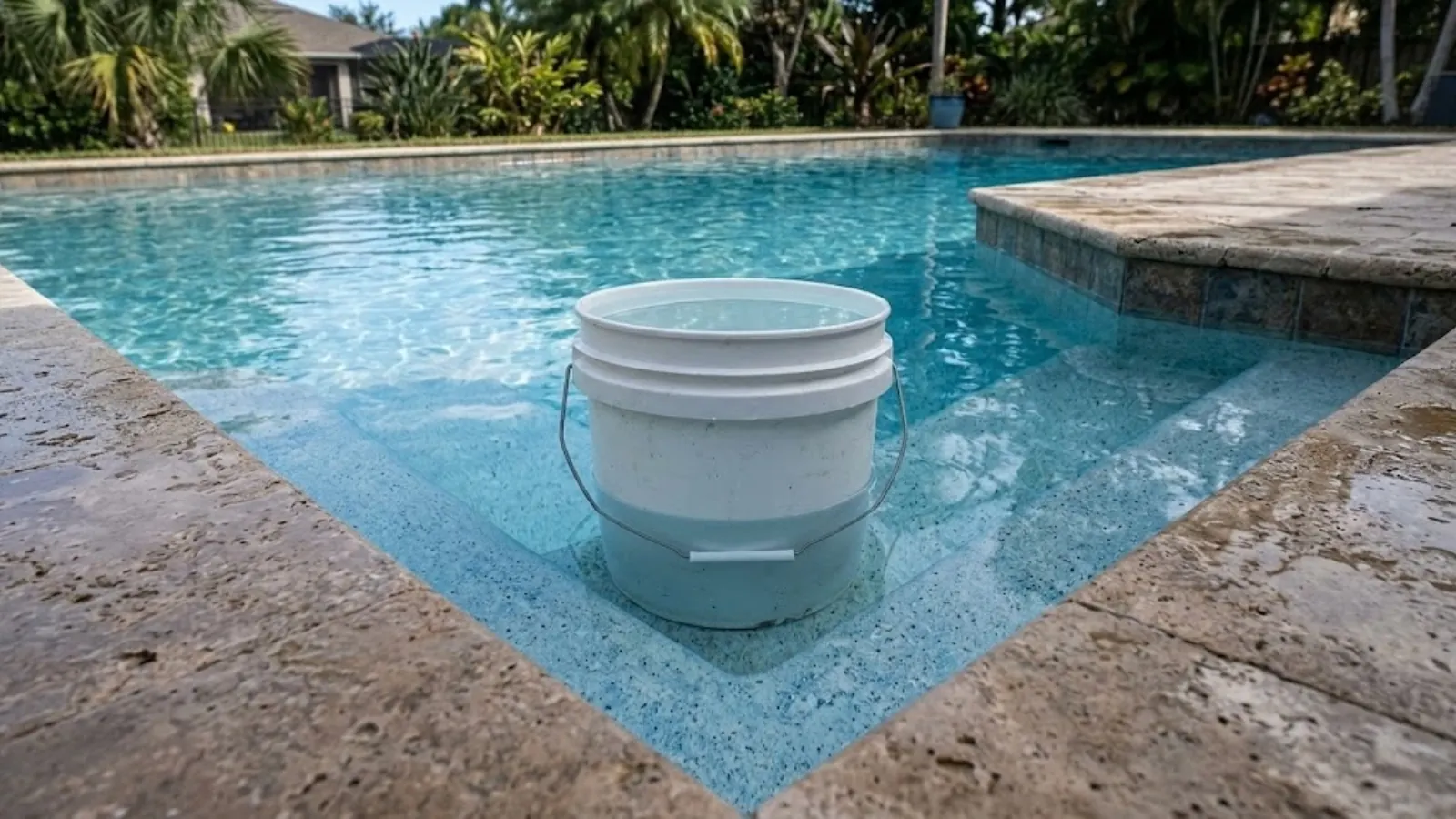
Every pool loses some water to evaporation, and in Costa Mesa the loss can jump on hot, dry, windy days, especially during Santa Ana wind conditions. The way to tell normal evaporation from a leak is the bucket test: a bucket of pool water set on a step loses water to evaporation at about the same rate as the pool. If the pool drops clearly faster than the bucket over the same day, water is leaving some other way.
This guide walks through the test, where leaks usually are, and what happens next.
The bucket test, done right
- Fill the bucket. Set a bucket on the first or second pool step and fill it to match the pool level.
- Mark both levels. Mark the water line inside the bucket and on the pool tile or skimmer.
- Run the pump normally. Keep the usual pump schedule and do not add water.
- Wait 24 hours. Avoid swimming, splashing and rain during the test.
- Compare the drops. A pool that fell clearly more than the bucket is leaking.
Then repeat the test with the pump off for 24 hours. The difference between the two runs points to where the leak is.
What the two test runs tell you
| Result | Likely leak area | Next step |
|---|---|---|
| Loses more with the pump on. | Pressure side, the return lines or equipment. | Pressure-test the returns. |
| Loses more with the pump off. | Suction side or the shell. | Test suction lines and dye-test the shell. |
| Loses the same either way. | The shell, a fitting or the light niche. | Dye testing at fittings. |
| Stops dropping at a certain level. | At that level: skimmer, light or a crack. | Inspect at the waterline. |
Why the water bill is often the first clue
Many pools have an automatic fill valve that tops up the water from the house supply. A leak is then hidden: the level looks fine, but the fill runs constantly and the water bill climbs.
If your bill jumped and you have a pool, turn the auto-fill off for the bucket test. An automatic fill line connected to the house also needs backflow protection under the California Plumbing Code, which is based on the Uniform Plumbing Code (UPC), so pool water cannot be drawn back into the drinking water.
If the pool holds steady with the fill off but the meter still moves, the leak is elsewhere. Our leak detection page covers house and yard lines.
Places to look yourself first
Safe checks from the deck and equipment pad, before calling anyone.
- Wet soil, puddles or drips around the pump, filter and heater.
- Cracks where the skimmer meets the pool wall.
- Loose or missing tiles at the waterline.
- A soggy patch of yard between the pool and the equipment pad.
- The light niche, where the cord enters the housing.
Do not enter the water to inspect a light or fitting. Leave underwater work to someone with the right equipment.
How a pro pinpoints and fixes it
Each pool line is plugged and pressure-tested. A line that loses pressure is leaking, and a listening device on the deck above narrows down where. Fittings, cracks and the light niche are checked with dye, which is drawn toward a leak.
Many leaks at fittings and cracks are sealed underwater without draining the pool. A broken underground line means opening the deck at the marked spot. The full process is on our pool leak detection page.
Draining a pool to look for a leak is rarely the first step, and draining can itself cause problems for some pool shells. Test first.
Evaporation versus leak: the local weather factor
Evaporation is not constant. It climbs with heat, sunshine, low humidity and wind, and it slows on cool, overcast, still days. A week of dry offshore wind can make a healthy pool look like it is leaking, while a real leak can hide during a humid, overcast week.
That is why a single day's drop, taken alone, tells you little. The bucket sits in the same weather as the pool, so comparing the two cancels the weather out. If you want extra confidence, run the test twice on different days and compare. A leak shows up both times.
A pool cover also changes the math. Covers cut evaporation sharply, so a covered pool that still drops steadily deserves a closer look.
Equipment pad leaks are the easy ones
The pump, filter, heater and valves sit above ground, so leaks there are often visible once you look. A drip at the pump shaft seal, a cracked union, or a filter tank O-ring that has flattened with age are common finds. These are usually the cheapest pool leaks to fix.
Look at the pad with the pump running, since some leaks only appear under pressure. Wet soil under the pad that never dries is a strong clue, even if you cannot see a drip.
Typical repairs and what they involve
| Leak | Usual repair | Disruption |
|---|---|---|
| Pump seal or union at the pad | Replace the seal or fitting. | Minimal. |
| Skimmer or light niche seam | Seal underwater with pool-rated putty or epoxy. | Minimal. |
| Crack in the shell | Seal or patch, depending on size. | Low to moderate. |
| Underground return or suction line | Open the deck at the spot and replace the section. | Moderate. |
| Multiple failing lines | Replumb the affected lines. | Larger project. |
Keep the pool filled above the skimmer while you wait for a repair, so the pump never runs dry.
When the pool is not the problem
A wet spot near a pool is not always the pool. The house service line, an irrigation valve or a hose bib can leak nearby too. Running the meter test with the pool auto-fill off separates the two. Owners in nearby cities can find local notes on our Newport Beach page.
Pool leak questions
It varies with sun, wind and humidity. The bucket test is more reliable than any rule of thumb.
Often, yes. Many fitting and crack leaks are sealed underwater, and line repairs are done from the deck.
An automatic fill valve may be replacing leaked water. Turn it off and run the bucket test.
Usually not the pool itself. Damage to the house from a pool leak may be treated differently. Check your policy.
Both, in separate 24-hour runs. The difference points to the pressure side, the suction side or the shell.
Most pools take a few hours to pressure-test and dye-test. A pool with an attached spa and more lines can take longer.
Sources
- California Building Standards Commission, California Plumbing Code (Title 24, Part 5).
- Mesa Water District, Water Quality.
General information only. For your home, a plumber on site has the final word.