Repiping a 1950s Costa Mesa Ranch Home: Copper or PEX?
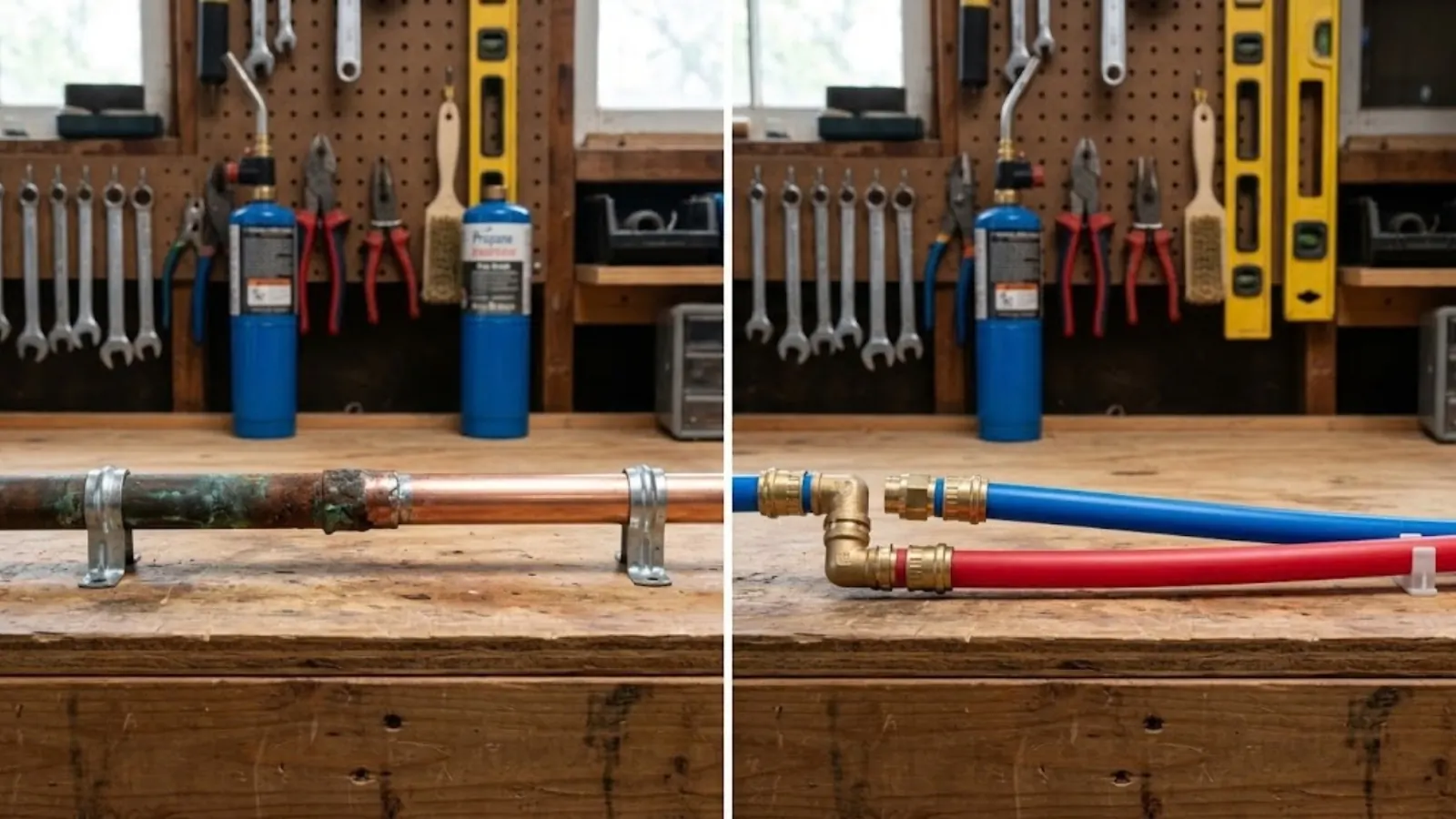
For most 1950s and 1960s ranch homes in Costa Mesa, both copper and PEX are sound choices for a whole-house repipe. PEX usually costs less and needs fewer wall openings. Copper costs more, suits owners who prefer rigid metal pipe, and handles sun exposure better. Both are approved under the California Plumbing Code, and both should outlast the pipe they replace by decades.
This guide covers how to tell your home needs a repipe, how the two materials compare in a single-story ranch, and what repipe week looks like. The postwar tracts of Westminster share the same pipe history.
Signs your ranch home is due
One problem is a repair. Several together point to a repipe.
- Brown or rusty water when you first open a cold tap.
- Pressure that has faded over the years at several fixtures.
- More than one pinhole leak or pipe repair in a few years.
- Galvanized pipe visible at the water heater, under sinks or at hose bibs.
- A slab leak that has already been repaired once.
Not sure whether you have a hidden leak or a failing system? Leak detection answers that before you commit to anything.
Why so many Costa Mesa homes are at this point
Costa Mesa incorporated in 1953, and much of its housing went up in the decade that followed. Eastside ranch homes on lots around 6,000 square feet, the Westside's early tracts and the mid-century homes of Mesa Verde were built with the materials of the time: galvanized steel supply lines in many homes, and early copper in others.
Galvanized pipe rusts from the inside until flow drops and a thin spot gives way. Older copper tends to fail through pinholes, especially on hot lines and where the pipe rubs framing or concrete. Either way, at 60 or 70 years old, the question is usually when, not whether.
Copper vs PEX in a single-story ranch
| Point | Copper | PEX |
|---|---|---|
| Material cost | Higher. | Lower. |
| Labor | More joints, soldered or pressed. | Fewer fittings, long flexible runs. |
| Wall openings | More, for straight runs and turns. | Fewer, tubing fishes through walls. |
| Attic routing | Rigid runs with supports. | Flexible runs, easy to route over ceilings. |
| Sun and outdoor exposure | Tolerates it. | Must be shielded from sunlight. |
| Noise | Can transmit water hammer. | Quieter with pressure changes. |
| Code status | Approved. | Approved under the California Plumbing Code. |
In a single-story ranch with an open attic, PEX's flexibility is a real advantage. Lines drop from the attic to each fixture with short, neat runs, which keeps wall patching to a minimum.
How the route works in a slab home
Most ranch homes here sit on concrete slabs, and many original supply lines run through or under the slab. A repipe almost never breaks the slab. The new lines run through the attic and drop down inside walls, and the old under-floor lines are capped and abandoned.
That approach also removes future slab leak risk on those lines. If you are weighing a slab leak repair right now, compare it with a repipe first. Our slab leak repair page sets the options side by side.
Moving the lines into the attic makes them accessible for decades. A future repair means opening a ceiling, not a floor.
What repipe week looks like
A typical single-story ranch takes two to four working days.
- Walkthrough and route. We plan each run, protect floors and mark where walls open.
- Run new lines. New pipe goes in while the old system still serves the house.
- Switch fixtures over. Each fixture moves to the new lines, usually over one or two days.
- Pressure test and inspect. The system is tested and the city inspects under the California Plumbing Code, which is based on the Uniform Plumbing Code (UPC).
- Patch. Wall openings are patched and ready for paint.
Water is off during working hours only. Most families stay home.
What moves the price
| Factor | Effect |
|---|---|
| Number of bathrooms and fixtures | More fixtures mean more pipe and connections. |
| Material | Copper typically costs more than PEX. |
| Attic access | Low or cramped attics slow routing. |
| Additions and remodels | Past additions can complicate routes. |
| Patching and paint | Drywall patching is usually included; painting often is not. |
For a firm number, see our repipe pricing page. Planned repipes get a free estimate.
Questions to ask before you sign
A repipe quote should answer a few specific questions. Does it cover every fixture, including hose bibs, the water heater connections and the laundry box, or only the interior lines? Does it replace the main line from the house shutoff, and does it include a new shutoff valve?
Ask how many wall openings to expect and who patches them. Ask whether the permit and the inspection are in the price. And ask what happens to the old pipe: in most slab homes it is capped and left in place, which is normal and saves a great deal of demolition.
Finally, ask about water pressure. A new system is the right time to test incoming pressure and replace a worn pressure reducing valve, so the new pipe is not stressed from day one.
One more practical point: ask how the crew protects the house. Floors, furniture and attic insulation all get disturbed during a repipe, and a good plan covers drop cloths, dust control and where tools and pipe are staged. It is a small detail that decides whether the week feels like a remodel or a minor inconvenience.
Planning an ADU or remodel?
Many Eastside lots have room for an accessory dwelling unit. If you are planning one, repipe the main house at the same time or first. It is the moment to confirm the water service line and meter can handle the added fixtures, and to size the new lines for the whole property rather than patching later.
Repiping questions
Yes. PEX is approved for water supply under the California Plumbing Code, and the city inspects it like any repipe.
Almost never. New lines go through the attic and walls, and old under-slab lines are abandoned.
Usually two to four working days, with water on each evening.
Some buyers prefer copper, but a permitted PEX repipe is a strong selling point too. Keep the permit and invoice either way.
Yes. We stop the leak first, then give you a repipe estimate to consider.
Before, or during. Walls are already open during a remodel, so new supply lines go in with less patching, and you avoid opening finished walls later to replace old pipe behind new tile.
Sources
- City of Costa Mesa, city history.
- California Building Standards Commission, California Plumbing Code (Title 24, Part 5).
General information only. For your home, a plumber on site has the final word.