Tank or Tankless: Choosing a Water Heater for a Mid-Century Mesa Verde Home
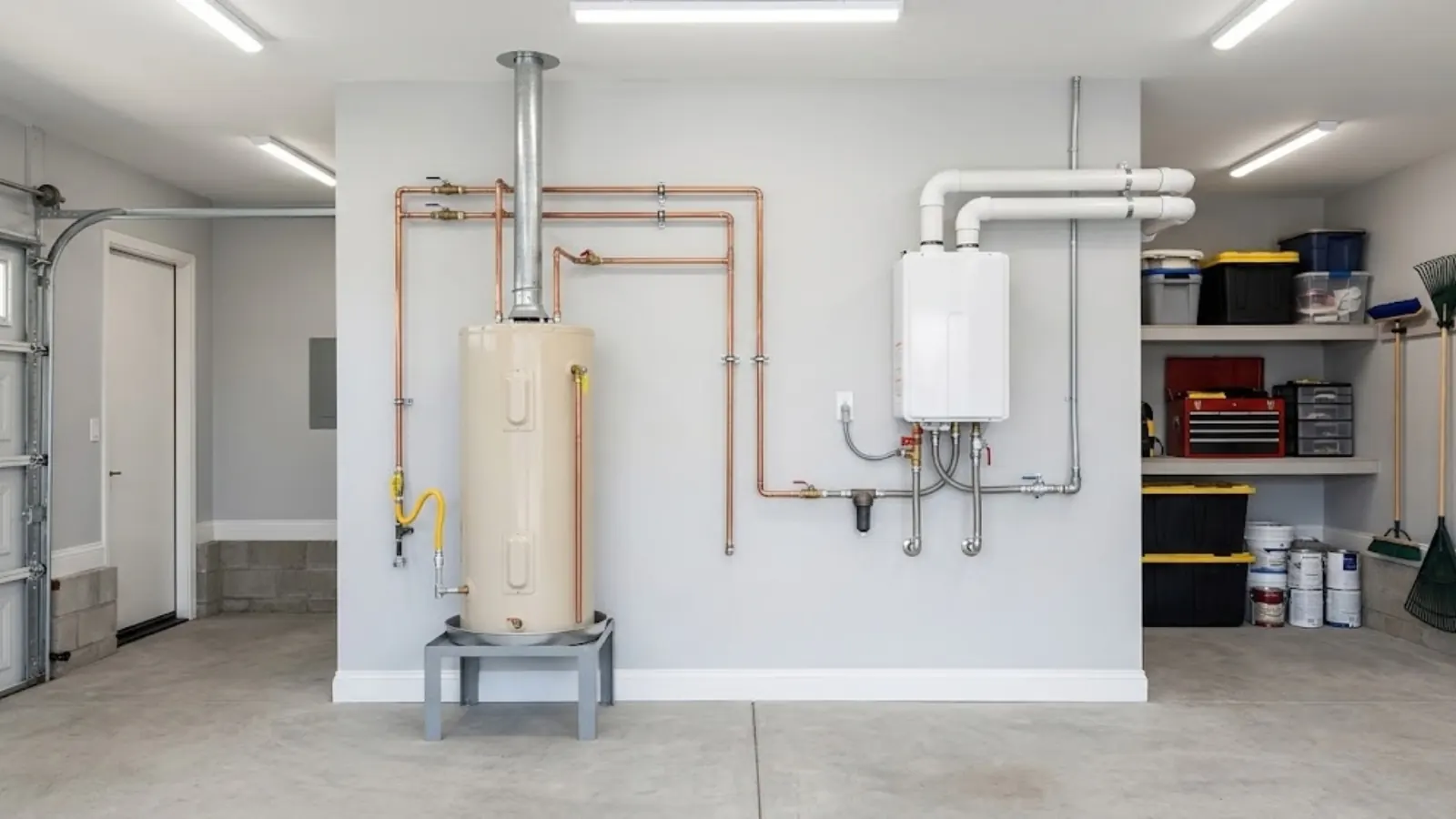
For most mid-century homes in Mesa Verde, a new tank water heater is the simplest and cheapest replacement. A tankless unit makes sense when you keep running out of hot water, want garage floor space back, or plan to stay long enough to recover the higher installation cost. The deciding factor is often not the heater at all. It is whether the home's original gas line and venting can support a tankless unit without major upgrades.
Here is how the choice plays out in a typical Costa Mesa home of that era. Owners in the 1960s tracts of Fountain Valley face the same gas line question.
What Mesa Verde homes usually have now
Mesa Verde is a neighborhood of mid-century tract homes built around two golf courses. In many of these houses the water heater sits in the garage, often a 40 or 50 gallon gas tank, fed by a gas line sized for a tank and a furnace, not for the much larger draw of a tankless unit.
Many garages also still have older installs: a single strap or plumber's tape instead of two seismic straps, no expansion tank on a home with a pressure reducing valve, or a relief line that does not run outside. Whatever you choose, the replacement is the time to fix those.
Side by side
| Point | Tank (gas, 40 to 50 gallons) | Tankless (gas) |
|---|---|---|
| Hot water supply | Runs out after heavy back-to-back use. | Continuous, limited by flow rate. |
| Upfront cost | Lower, especially like-for-like. | Higher, often with gas and vent upgrades. |
| Gas line | Usually works with the existing line. | Often needs a larger line from the meter. |
| Venting | Reuses the existing flue in most cases. | New venting, and a condensate drain on condensing units. |
| Space | Takes garage floor space. | Wall-mounted. |
| Maintenance | Yearly flush recommended. | Descaling every one to two years. |
| Typical life | Commonly 8 to 12 years. | Often longer with regular descaling. |
The gas line question
A gas tank water heater might draw around 40,000 BTU per hour. A whole-house gas tankless unit is commonly rated at several times that. When it fires at full output at the same time as the furnace and the range, the gas piping has to carry the total load.
Gas piping is sized using the tables in the California Plumbing Code, which is based on the Uniform Plumbing Code (UPC). If the existing line is too small, the tankless unit will starve for gas, show errors or fail to reach temperature. Upsizing the line from the meter is a common and legitimate part of a tankless install, but it adds cost. Our gas line sizing and repair page covers what that involves.
A proper tankless quote includes a gas load calculation. A quote that skips it is guessing.
Local water and maintenance
Mesa Water's 2025 report lists 2024 groundwater hardness at an average of 6.4 grains per gallon, with a range from 1.2 to 14. At that moderate level, a tankless unit usually needs descaling every one to two years, and a tank benefits from a yearly flush.
Scale is the main reason tankless units lose output. If you go tankless, isolation valves make descaling quick and cheap, and our tankless service page covers the process.
Is gas still an option?
Yes, as of September 2026. In June 2025, the South Coast Air Quality Management District board voted against proposed rule changes that would have pushed water heater sales toward zero-emission units, so the existing rule stays in effect and gas replacements remain allowed.
A heat pump water heater is a third option for homes with the garage space and an available electrical circuit. It is worth a look, but check current incentive availability before counting on any rebate, since many programs have been fully reserved.
Sizing either option correctly
Tanks are sized by first-hour rating, printed on the label, which estimates how much hot water the tank can deliver in a busy hour. A household that runs two showers and a dishwasher in the same morning needs a higher rating than one person who showers alone.
Tankless units are sized by flow rate at a given temperature rise: how many gallons per minute the unit can heat from the incoming water temperature to the setting you want. A unit that is too small will struggle when two showers run at once, and the fix is a larger unit, not a longer wait. Ask the installer to show the flow rate they sized for and how many fixtures it covers at once.
Either way, the size should come from how your household actually uses hot water, not from what was there before. The old tank may have been undersized for years.
Questions that decide it
- Do you run out of hot water today? If not, a tank is usually enough.
- How long will you stay? Tankless pays back better over a longer ownership.
- Is the gas line sized for more load, and what does upsizing cost?
- Where would the venting run, and is there a drain for condensate?
- Would the freed garage floor space matter to you?
Ready to compare prices? Our installation team quotes both, with free estimates on planned replacements.
Permits and code, either way
Both options need a City of Costa Mesa permit. California law requires water heaters to be braced against earthquakes, and the plumbing code sets that at two straps on a tank. Gas units in garages must be raised 18 inches unless built to resist flammable vapor ignition. Tankless units need correct venting and clearance to windows and doors.
Skipping the permit may save a little now, but an unpermitted heater is a common flag at resale.
Tank vs tankless questions
Often, if the household runs out of hot water with a tank or values the space. The gas line upgrade cost is the main factor to price first.
Sometimes, but many mid-century homes need a larger line. A gas load calculation answers it.
Every one to two years for most homes, based on Mesa Water's moderate average hardness.
Yes, as of September 2026. The proposed regional rule change was not adopted in 2025.
Yes. The switch involves gas, venting and often electrical work, all inspected by the city.
A like-for-like tank swap usually takes a few hours. A tankless conversion with new gas piping and venting often takes a full day, sometimes two, plus the inspection.
Sources
General information only. For your home, a plumber on site has the final word.