Leak in a Costa Mesa Condo: Who Pays, the Owner or the HOA?
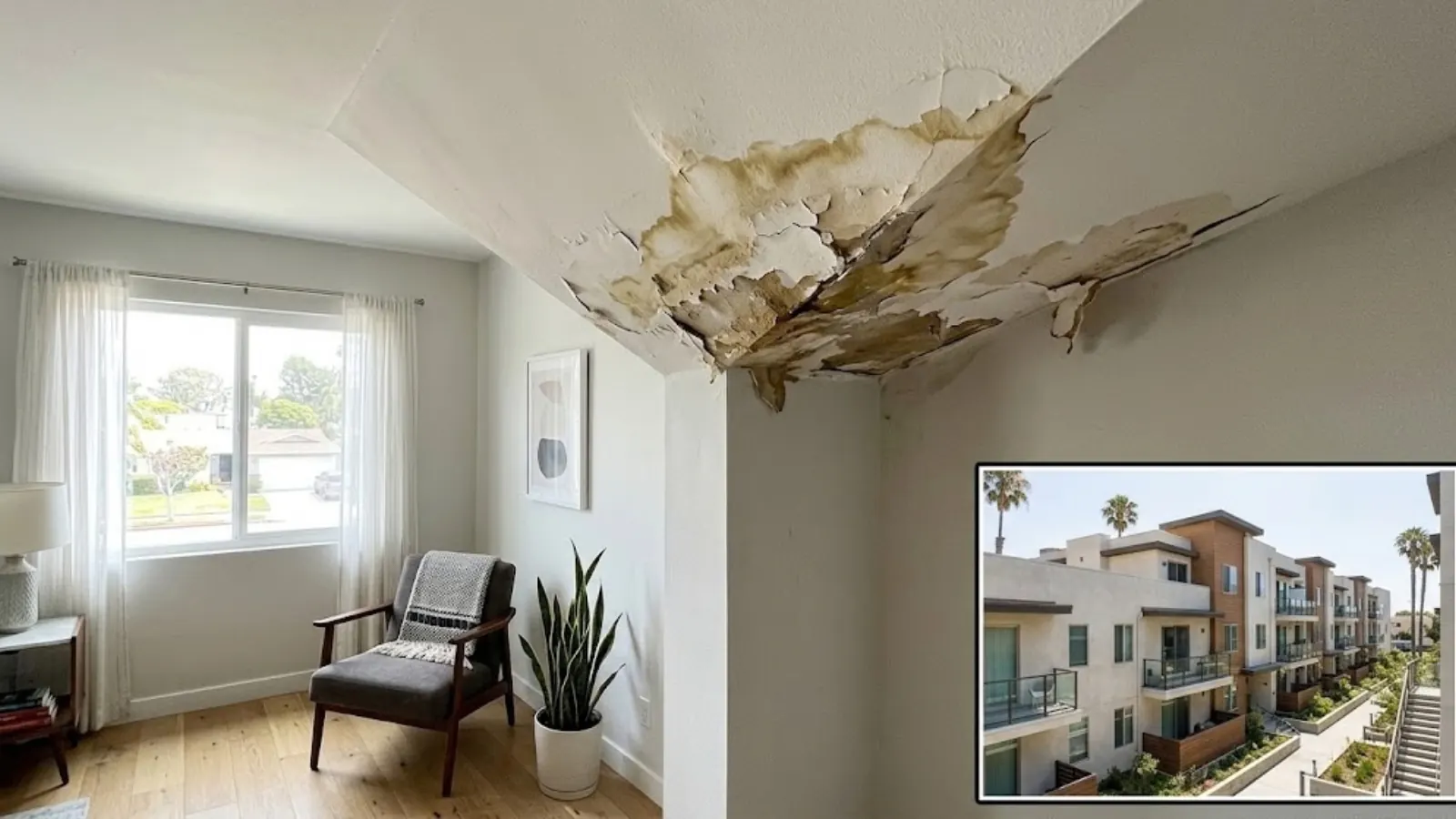
In a California condo, who pays for a leak usually depends on where the failed pipe or fixture is. Under the Davis-Stirling Act, the association generally repairs the common areas and the owner repairs their own unit, unless the CC&Rs say otherwise. So the first job after stopping the water is finding the source: your unit, a neighbor's unit, or a shared line in the walls or ceiling.
This guide walks through the first hour, how the source gets pinned down, and how costs are usually split. Condo owners in Newport Beach face the same questions under the same state law.
What to do in the first hour
- Stop the water if you can. Many units have a shutoff in a utility closet or under the water heater.
- Call the association's emergency number or property manager right away.
- If water is coming from above, knock on the neighbor's door and ask them to shut off their water.
- Turn off power to wet areas if the panel is dry and safe to reach.
- Photograph everything, including ceilings, walls and the neighbor's unit if they allow it.
Who usually pays, by leak source
This is the typical split. Your CC&Rs can change it, so read them or ask your manager.
| Leak source | Usually responsible | Why |
|---|---|---|
| Your toilet, faucet, dishwasher or water heater | You. | Fixtures that serve only your unit. |
| Supply line serving only your unit | Often you. | Depends on how the CC&Rs define your unit. |
| Shared riser or main line in the walls | Usually the association. | It serves multiple units. |
| Roof or exterior wall leak | Usually the association. | Common area. |
| Leak from the unit above | Often that owner, for their fixture. | The source unit's responsibility. |
Damage to your interior finishes and belongings is often a separate question from who fixes the pipe. Insurance usually decides that part.
What the law says, in plain terms
California's Davis-Stirling Act governs most condo associations. Its general rule is that the association is responsible for repairing and maintaining the common area, and each owner is responsible for their separate interest, which is usually the unit itself. The association's CC&Rs can shift those lines.
The hard part in practice is the pipes inside the walls. Some CC&Rs define the unit as the interior surfaces, making pipes inside the walls common area. Others include pipes that serve only one unit in that unit. That definition decides most disputes, so it is worth finding before anyone argues about a bill.
This is general information, not legal advice. For a dispute with the association, an attorney who handles HOA matters can read your CC&Rs and give a real answer.
How the source gets pinned down
- Moisture mapping. Meters show where water is spreading and where it is heaviest.
- Isolation. Shutting off your unit's water, then the neighbor's, shows whose system is leaking.
- Pressure tests. Testing lines by section confirms which pipe is failing.
- Thermal imaging. A hot line leak shows up inside walls and ceilings.
- Written findings. Photos and notes that the owner, neighbor and association can all see.
Our leak detection service documents findings so every party works from the same facts.
Insurance: your HO-6 and the master policy
Condo owners usually carry an HO-6 policy that covers their interior, improvements and belongings, while the association carries a master policy for the building. Which one responds depends on the source, your CC&Rs and the policies' own terms.
Report the leak to your own insurer promptly even if you think the association will pay. Deductibles, deadlines and who files first can all matter. Keep every photo, invoice and leak report.
Costa Mesa condos and common problems
Many Costa Mesa condos and townhomes, including those around South Coast Metro, date from the 1970s and 1980s. Buildings of that age commonly see failing supply risers, water heater leaks inside units, and drain stacks shared by several homes.
Water heaters deserve a special mention. A tank inside a hallway closet with no drain pan can soak the unit below when it fails. If your heater is past about ten years old and sits inside the unit, replacing it with a drip pan piped to a drain is cheap protection for you and your neighbor. Repairs inside the unit are permitted and inspected under the California Plumbing Code, which is based on the Uniform Plumbing Code (UPC).
Documents to gather
These make every conversation with the association, the neighbor and the insurers faster.
- Your CC&Rs, especially the sections defining the unit and maintenance responsibilities.
- The association's maintenance chart, if it has one.
- Your HO-6 policy declarations page.
- Photos and video from the first hour.
- The plumber's written leak findings and repair invoice.
Many associations publish a maintenance responsibility chart that spells out who handles pipes, water heaters and fixtures. If yours has one, it often settles the question faster than the CC&Rs.
Preventing the next leak
A few habits protect you and the units around you. Replace braided supply lines to toilets, sinks and the washing machine every several years, since a failed connector is one of the most common condo leaks. Know where your unit's shutoff is before you need it. And tell neighbors if you will be away, so someone can reach the shutoff in an emergency.
After the water is off
Drying matters as much as the repair. Water in shared walls and ceilings can spread into several units, and slow drying invites mold. Water mitigation is handled on a separate line listed on that page. For the pipe itself, a plumber repairs the failed section once the source is agreed.
Condo leak questions
Often the upstairs owner, if their fixture or unit-only pipe failed. If it is a shared line, usually the association. Your CC&Rs and insurance policies decide the details.
It depends on how your CC&Rs define your unit. Some make in-wall pipes common area, others make pipes that serve only your unit yours.
Stop the water if you can, call the association's emergency line, and ask the neighbor above to shut off their water. Then photograph everything.
Most condo owners carry an HO-6 policy for their interior and belongings. Check what your CC&Rs require.
Usually, yes, with moisture mapping, isolation and pressure tests. Written findings help settle who pays.
Call the association's emergency line first if the leak may involve a shared line or another unit. If the source is clearly your own fixture, such as a toilet supply line, stop the water and call a plumber.
It depends on the source and your CC&Rs. If a common-area pipe caused it, the association often handles the resulting damage too. Your HO-6 policy may cover the rest.
Sources
General information only. For your home, a plumber on site has the final word.